

USU Lecturers Conduct Pellet Feed and Granular Fertilizer Production Training in Simalungun Regency
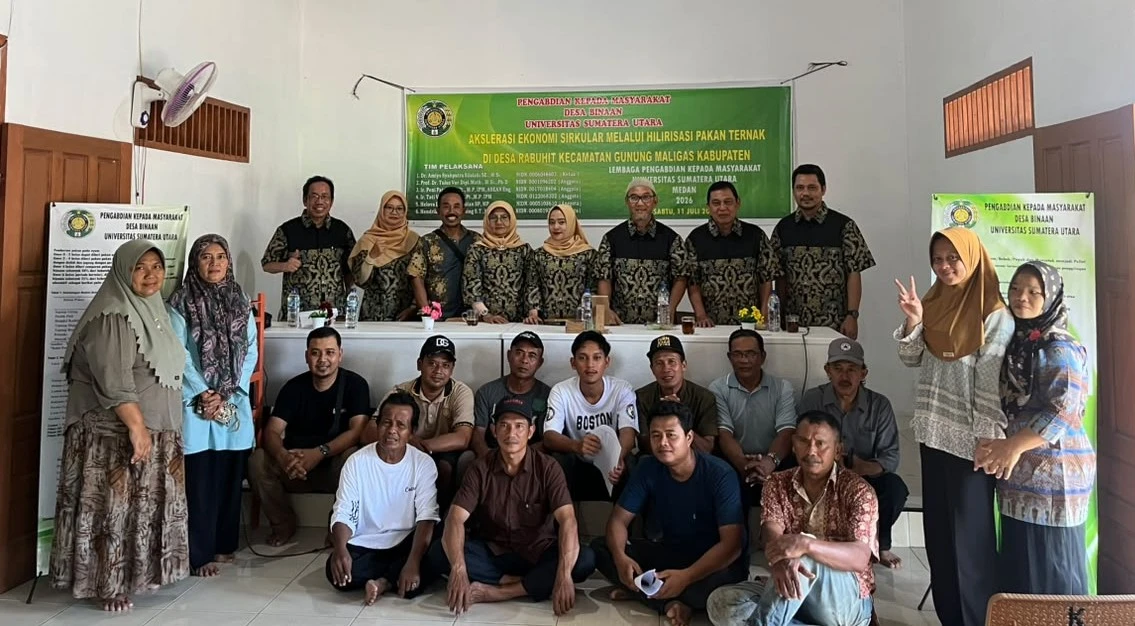


USU Lecturers Conduct Pellet Feed and Granular Fertilizer Production Training in Simalungun Regency
Published by
Raisha Andini
Published at
Thursday, 06 August 2026


SIMALUNGUN – USU PUBLIC RELATIONS: The Universitas Sumatera Utara (USU) Fostered Village Program in Rabuhit Village, Gunung Maligas District, Simalungun Regency, continues to demonstrate encouraging progress. Following its official launch during the first week of August, the USU community service team has now entered the implementation phase through a series of training sessions and mentoring activities focused on enhancing the community's technical skills in utilizing agricultural and livestock waste. The program aims to strengthen the community's economic independence through the application of appropriate technology, particularly pelletizer and granulator machines.
The first activity focused on training local farmers and livestock breeders to independently produce fish and poultry feed using a pelletizer machine. The fostered farmer-livestock group, led by Rohiman, received guidance on formulating locally sourced raw materials into nutritionally balanced feed that meets livestock nutritional standards. Through the mechanized pellet production process, the community is now able to produce high-quality, durable feed suitable for supporting catfish farming and poultry production in Rabuhit Village.
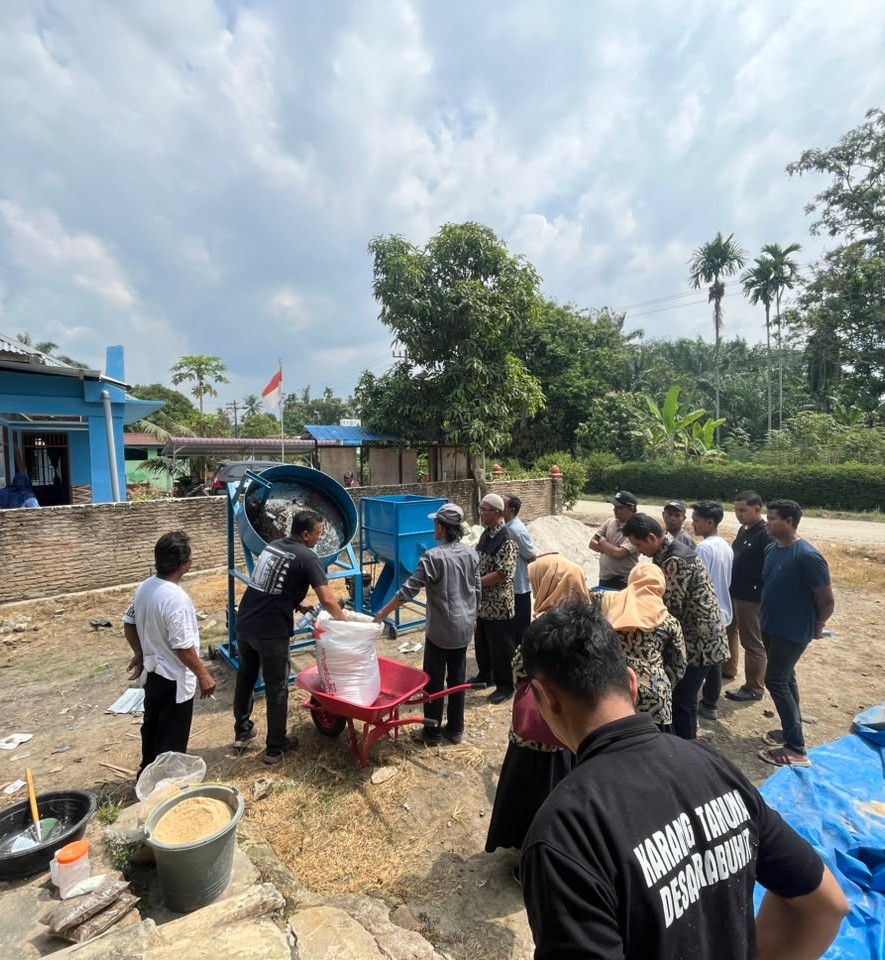
The ability to produce feed independently is expected to reduce production costs, which have long depended on commercial feed, while improving the efficiency of local livestock and aquaculture businesses.
The second activity emphasized optimizing the utilization of livestock waste through the use of a granulator machine. During the training, participants received both theoretical instruction and hands-on experience in processing cattle and goat manure into granular organic fertilizer with added economic value.
This technology not only helps reduce the accumulation of waste that could potentially pollute the environment but also produces organic fertilizer that is easier to apply, better preserves nutrient content, and has higher market value. The initiative forms part of a broader strategy to establish sustainable agricultural and livestock systems while improving environmental sanitation in the village.
The entire program is supported by the Institute for Research and Community Service (LPPM) USU and implemented by a multidisciplinary team led by Dr. Amlys Syahputra Silalahi, S.E., M.Si. Team members include Prof. Dr. Tulus from the Faculty of Mathematics and Natural Sciences (FMIPA); Ir. Peni Patriani, S.Pt., M.P., IPM., ASEAN Eng.; Ir. Tati Vidiana Sari, S.Pt., M.P., IPM.; and Helova Leonard Panjaitan, S.P., M.P. from the Faculty of Agriculture, as well as Hendrik Voice Sihombing, S.T., M.T. from the Faculty of Engineering.
As of July 2026, the implementation of the Fostered Village Program has achieved 87 percent of its targeted objectives. This achievement indicates that the technologies introduced to the community, namely the pelletizer and granulator machines, have been successfully adopted and utilized by the targeted farmer-livestock groups.
The program has delivered tangible benefits by increasing the productivity of community-based farming enterprises. The use of high-quality pellet feed has improved livestock and aquaculture production, while the application of granular organic fertilizer has enhanced agricultural productivity and created new business opportunities through the marketing of organic fertilizer. These outcomes have directly contributed to increasing household incomes and strengthening the village's economic independence.
The mentoring program will continue through November 2026, accompanied by regular evaluations to ensure that every stage of implementation proceeds effectively. Through the adoption of these technologies, Rabuhit Village is expected to establish a Zero Waste system—an integrated agricultural and livestock cycle in which waste is recycled into economically valuable resources.
The USU Fostered Village Program also represents the university's tangible contribution to achieving the Sustainable Development Goals (SDGs), particularly SDG 3 (Good Health and Well-being) by fostering a healthier environment, and SDG 8 (Decent Work and Economic Growth) by increasing productivity and creating sustainable economic opportunities for the people of Rabuhit Village.


