A11Y

HOME

MENU

CARI

USU Lecturer Explains the Role of Cryptography Behind Secure Digital Activities

Published At31 July 2026
Published ByRaisha Andini
USU Lecturer Explains the Role of Cryptography Behind Secure Digital Activities
Copy Link
IconIconIcon

USU Lecturer Explains the Role of Cryptography Behind Secure Digital Activities


Published by

Raisha Andini

Published at

Friday, 31 July 2026

Logo
Download

Cryptography, a field of knowledge that dates back thousands of years, has become the foundation that secures nearly every aspect of modern digital life, from online banking transactions to prepaid electricity tokens. This was explained by Dian Rachmawati, a lecturer in the Undergraduate Computer Science Study Program at the Faculty of Computer Science and Information Technology (Fasilkom-TI), Universitas Sumatera Utara (USU).
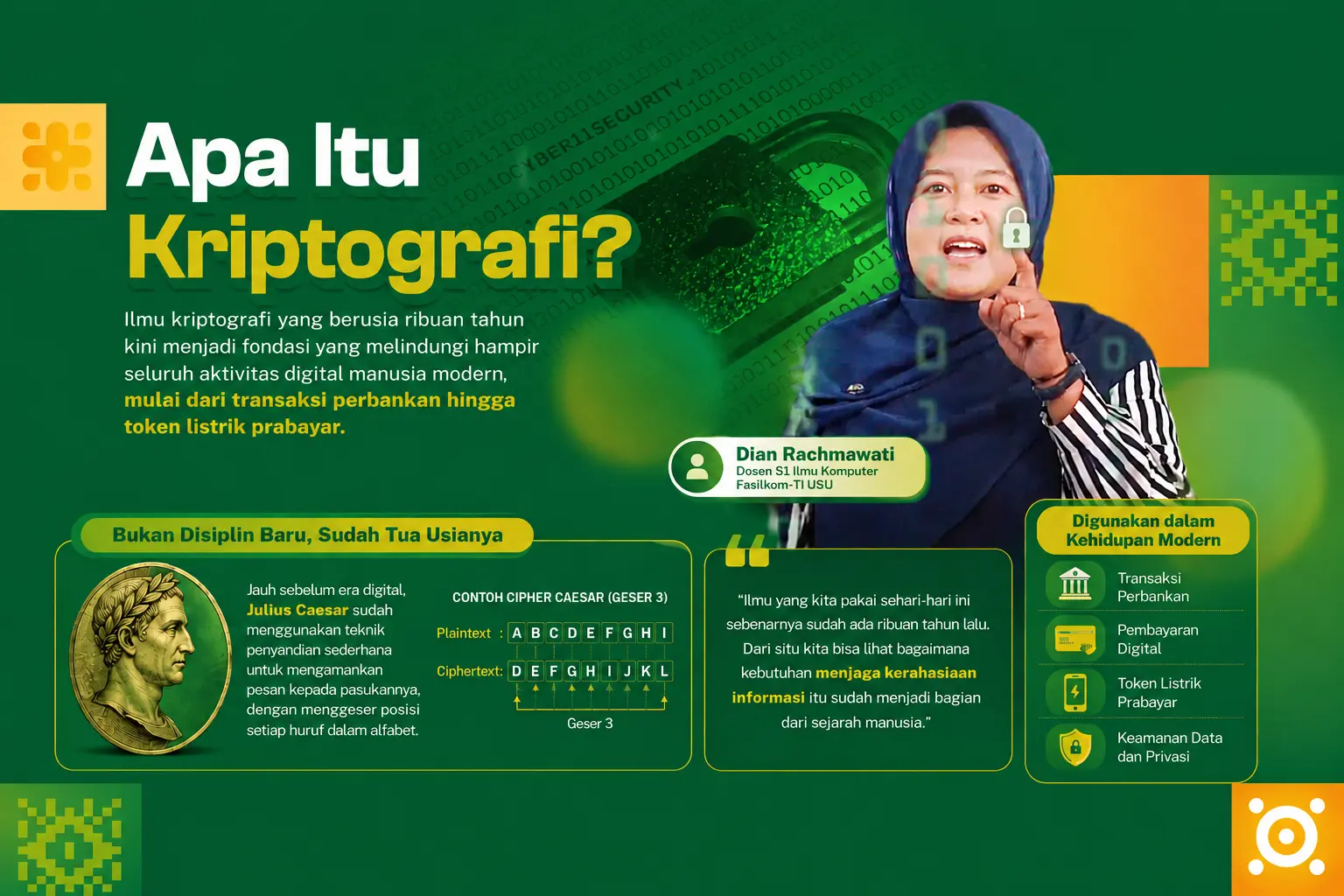
According to Dian, cryptography is far from a new discipline. Long before the digital era, Julius Caesar employed a simple encryption technique to secure messages sent to his troops by shifting the position of each letter in the alphabet.

“The science we rely on every day has actually existed for thousands of years. It shows that the need to protect confidential information has always been an integral part of human history,” Dian said.

She explained that encryption techniques have continued to evolve over the centuries. During World War II, Germany relied on the Enigma machine to secure military communications before it was ultimately deciphered by Polish and British cryptographers, including Alan Turing, who designed the Bombe machine. This breakthrough later became one of the cornerstones of modern computer science.

Dian noted that the same fundamental principles now operate behind almost every digital activity people perform daily. Online banking transactions and e-commerce purchases are secured using encryption protocols such as TLS/SSL. Messaging applications such as WhatsApp and Signal employ end-to-end encryption, ensuring that only the sender and recipient can read the contents of their conversations.

“Even the service providers themselves technically cannot read messages protected by end-to-end encryption. The same principles are also applied in digital signatures, government services, electronic medical records, and even digital currencies,” she explained.

She added that cryptographic principles are also embedded in Internet of Things (IoT) devices such as smart door locks and home security cameras, as well as in systems that appear relatively simple, such as the 20-digit prepaid electricity tokens purchased by customers each month. These tokens are generated using standardized cryptographic methods, ensuring that a token issued for one electricity meter cannot be used on another.

Dian emphasized that no cryptographic system is completely flawless. The security of any system depends on the strength of its algorithms, proper key management, and the quality of its implementation.

“Breaking a well-designed encryption system requires an enormous amount of computational resources. Without access to the system's secret key, doing so is practically impossible. Beyond the technical challenge, attempting to break such systems is also a violation of the law,” she said.

According to Dian, expertise in cryptography and cybersecurity is among the most sought-after skills in today's job market, driven by the rapid growth of digital transactions, e-government services, and the widespread adoption of Internet of Things technologies across multiple sectors. The demand for professionals in this field now extends beyond the technology and banking industries to government institutions, healthcare services, and the energy sector, all of which increasingly depend on digital systems for their daily operations.

At Universitas Sumatera Utara, Computer and Data Security has become one of the key academic focus areas continuously developed by Fasilkom-TI through both teaching and research conducted by lecturers and students. Dian believes that a thorough understanding of cryptographic principles provides Computer Science students with an essential foundation for careers in an increasingly digital industry while also enabling USU graduates to contribute to strengthening Indonesia's national cybersecurity ecosystem.

Accessibility Features

  • Grayscale

  • High Contrast

  • Negative Contrast

  • Text to Speech

icon

Chatting with

Halo USU

Halo,
Dengan Layanan Bantuan USU
Ada yang bisa kami bantu hari ini?
-Admin