

USU Expert Team Assesses SELCARE’s Readiness for Elderly Healthcare Technology Commercialization
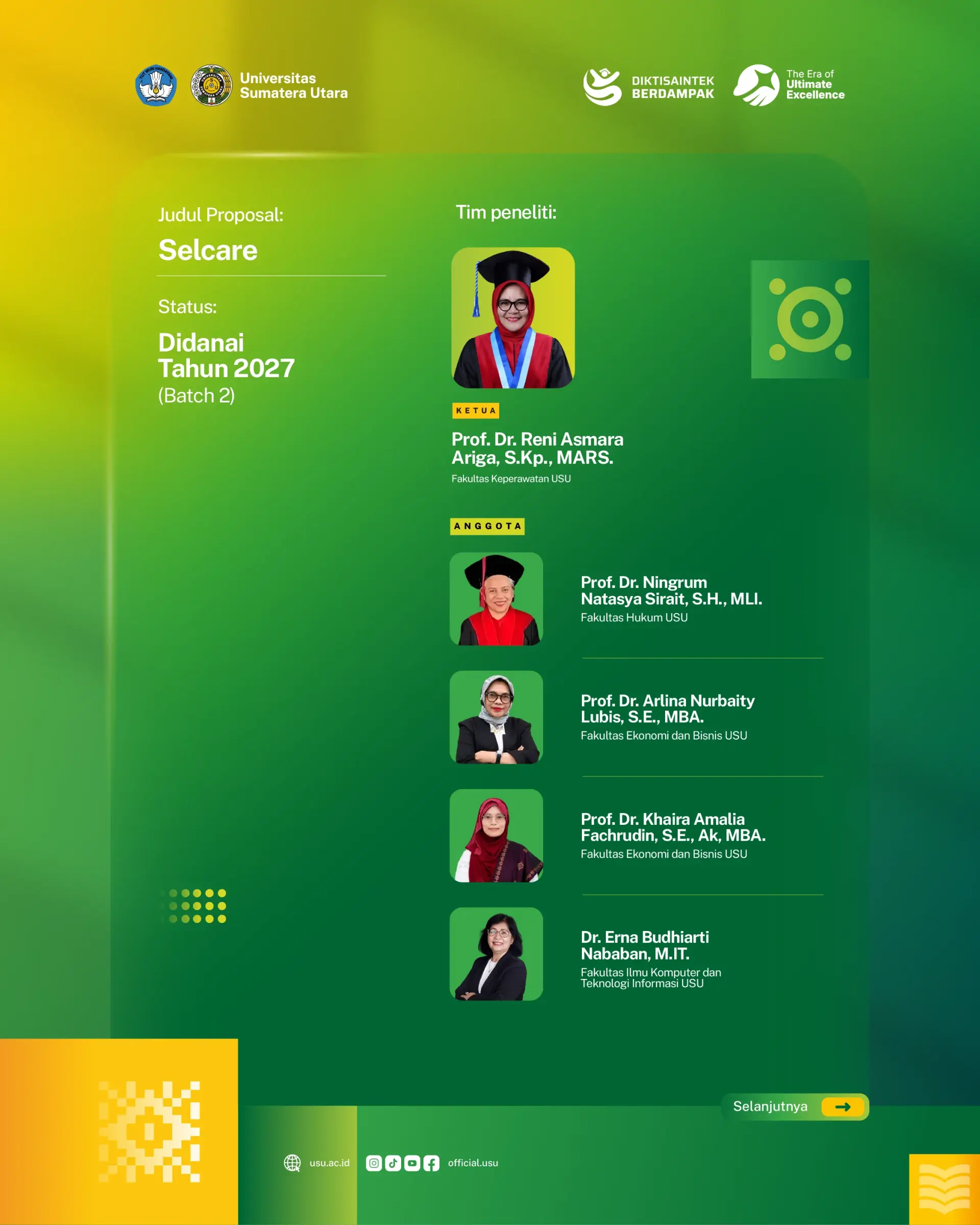


USU Expert Team Assesses SELCARE’s Readiness for Elderly Healthcare Technology Commercialization
Published by
Raisha Andini
Published at
Thursday, 01 October 2026


SELCARE integrates AI Adaptive Cognitive Assessment, longitudinal monitoring of users’ conditions, and a Decision Support System. This integration enables the platform to provide cognitive training recommendations tailored to users’ conditions while supporting healthcare professionals in making informed decisions.
USU PUBLIC RELATIONS – Universitas Sumatera Utara (USU), through a multidisciplinary team of experts, is participating in the Pre-Feasibility Study Program for Fiscal Year 2027 under the Research Commercialization–Technology Promotion scheme of the Directorate General of Research and Development, Ministry of Higher Education, Science, and Technology of the Republic of Indonesia (Kemdiktisaintek RI). The program is aimed at assessing the readiness of SELCARE, a web-based digital platform developed to support the early detection, monitoring, and cognitive function training of older adults.
Team Leader Prof. Dr. Reni Asmara Ariga, S.Kp., MARS., explained that the assessment goes beyond technology development. The team is also examining the extent to which SELCARE can be further developed and utilized on a broader scale before entering the commercialization stage.
“Our role is not merely to develop the technology, but also to assess whether SELCARE has achieved sufficient readiness to enter the commercialization stage,” Prof. Reni explained.
SELCARE integrates AI Adaptive Cognitive Assessment, longitudinal monitoring of users’ conditions, and a Decision Support System. This integration enables the platform to provide cognitive training recommendations tailored to users’ conditions while also supporting healthcare professionals in their decision-making processes.
Involving Five Experts with Different Areas of Expertise
To obtain a more comprehensive assessment of its feasibility, the SELCARE study involves five experts from different academic backgrounds. Prof. Reni Asmara Ariga serves as the Team Leader, coordinating the overall process and integrating the assessment findings from various aspects.
The team also includes Dr. Erna Budhiarti Nababan, M.IT., an expert in information technology and artificial intelligence/technical aspects; Prof. Dr. Arlina Nurbaity Lubis, S.E., MBA., an expert in marketing management, markets, and business models; Prof. Dr. Khaira Amalia Fachrudin, S.E., Ak., MBA., an expert in finance and risk; and Prof. Dr. Ningrum Natasya Sirait, S.H., MLI., an expert in regulatory and legal matters.
Each expert conducts an assessment according to their respective area of expertise. The findings are then discussed and integrated to provide an overall picture of SELCARE’s readiness. The team will also involve Focus Group Discussions (FGDs) and business matching activities to connect the technology with potential partners who could support its commercialization process.
“The collaboration is multidisciplinary. Each expert conducts an assessment based on their expertise, and we then integrate the findings into a single feasibility assessment framework,” Prof. Reni said.
Assessing Technology Readiness and the Commercialization Pathway
As part of the assessment, the team will examine several aspects that will serve as the basis for determining the future direction of SELCARE’s development. The assessment covers technology readiness, technical aspects, market and business models, financial and economic feasibility, risks, legal and regulatory aspects, and commercialization plans.
From the technical perspective, the team will assess the technology’s readiness and its supporting validation evidence. From the market and business perspectives, the assessment will examine user needs, market conditions, competitors, business models, and potential commercialization strategies.
Financial aspects are also an important component in assessing investment requirements, costs, potential revenue, and economic feasibility. Meanwhile, risk and legal assessments will identify potential risks, including intellectual property protection, licensing, and compliance with applicable regulations.
According to Prof. Reni, innovation cannot be assessed solely from a technological perspective. Its potential applications must also be demonstrated through measurable assessments to ensure that the technology being developed has a clear path toward implementation.
“We must demonstrate its technical readiness, market needs, business model, regulatory aspects, financial feasibility, and implementation risks. Innovation must therefore be supported by evidence, not merely claims,” she emphasized.
Opening Opportunities for Use in Elderly Healthcare Services
SELCARE has the potential to be developed for use in various healthcare settings serving older adults. The platform could support services at community health centers (puskesmas), elderly integrated health posts (posyandu lansia), clinics, hospitals, nursing homes, and community-based healthcare services.
One of the key strengths being assessed is SELCARE’s integration of AI-based adaptive cognitive assessment, monitoring of users’ conditions over a period of time, and a decision support system within a single platform. Its adaptive approach allows the difficulty level of the assessment to be adjusted according to users’ performance.
Nevertheless, the expert team continues to prioritize evidence and implementation readiness as the primary basis for determining the technology’s future development.
Preparing Recommendations for the Next Stage
Upon completion of the assessment, the team aims to produce a Pre-Feasibility Study that can serve as a basis for determining SELCARE’s next steps. The findings will provide an overview of the technology’s current position, aspects that still need to be strengthened, and potential commercialization pathways.
The team will also identify potential users and partners who could support SELCARE’s development. FGDs and business matching activities are part of this effort, enabling the technology’s needs to be matched with parties that have the capacity to implement it.
“The final output is not simply a statement on whether the technology is feasible or not. Rather, it will provide operational recommendations: what needs to be improved, who the potential users or partners are, the implementation model, further development requirements, and strategies to mitigate risks before entering the commercialization stage,” Prof. Reni concluded.


