

Prof. Muryanto Amin Affirms USU's Strategic Policy Direction Centered on Five Key Pillars
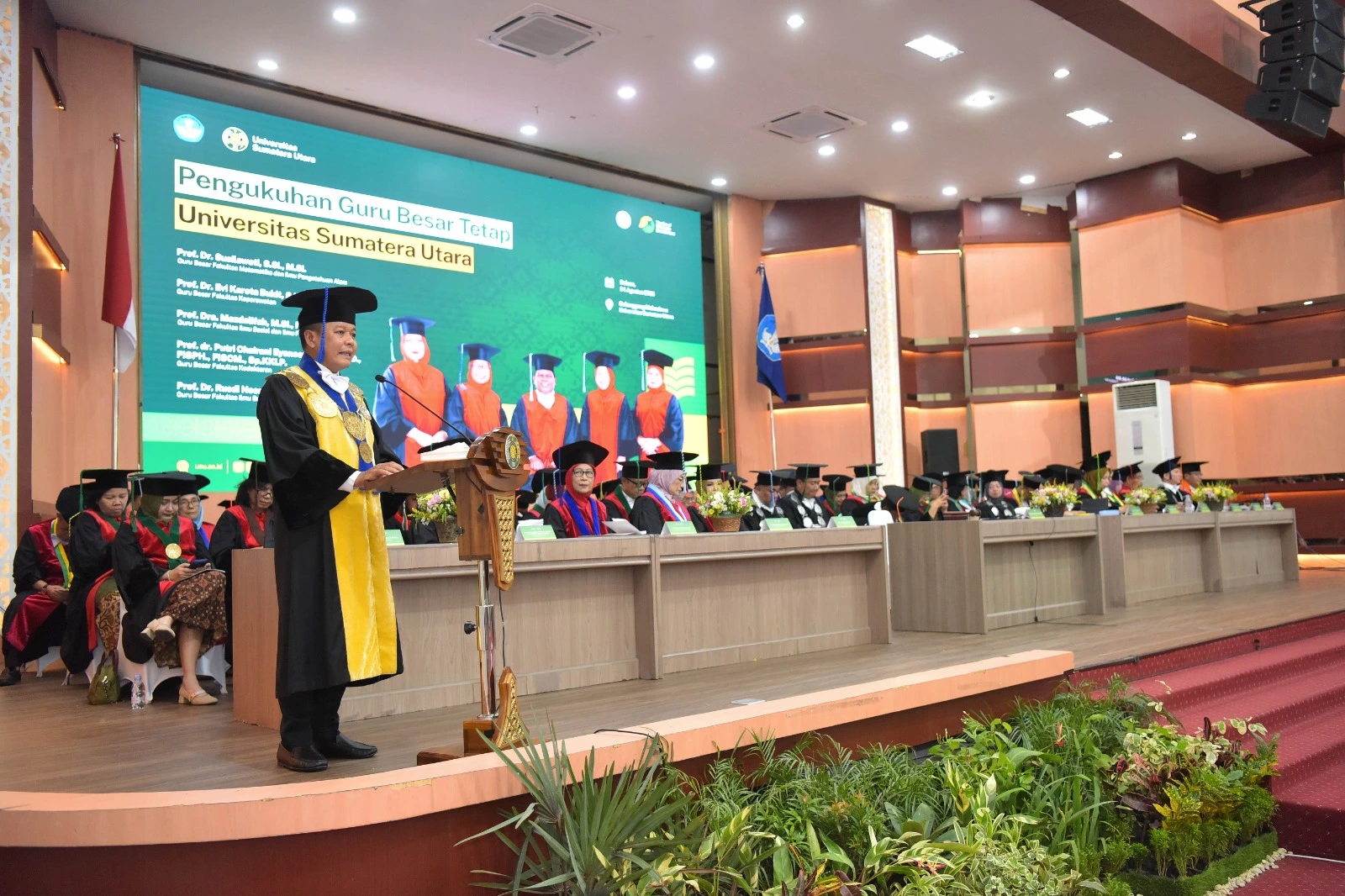


Prof. Muryanto Amin Affirms USU's Strategic Policy Direction Centered on Five Key Pillars
Published by
Raisha Andini
Published at
Tuesday, 04 August 2026


MEDAN – USU Public Relations: Universitas Sumatera Utara (USU) has established its strategic policy direction for the 2026–2031 period, focusing on five key pillars aimed at accelerating institutional quality improvement and expanding the university's contribution to providing solutions for national development.
The policy was reaffirmed by the Rector of Universitas Sumatera Utara, Prof. Dr. Muryanto Amin, S.Sos., M.Si., during the inauguration ceremony of five new USU professors held at the Student Center on Tuesday (4 August). He explained that the first pillar is strengthening adaptive governance, which serves as the foundation for building a management system that is responsive to change. The second pillar, the development of a Tri Dharma-driven university, positions education, research, and community service as the primary drivers of all institutional activities.
The third pillar focuses on digitalization and the development of a smart campus to improve efficiency, transparency, and the quality of academic services. Meanwhile, strengthening the university's enterprise initiatives and endowment fund is regarded as a strategic step toward achieving greater financial independence.
The fifth pillar emphasizes internationalization and strengthening USU's global brand to expand international partnerships and enhance the university's global reputation.
"These five pillars are interconnected and cannot be implemented separately. The Tri Dharma must serve as the core engine that drives all university activities," he said.
Prof. Muryanto also noted that one of the key challenges facing professors is translating philosophical thinking into practical action that delivers meaningful and relevant outcomes.
"To address both global and national challenges, we must honestly and objectively understand Universitas Sumatera Utara's position through comparative evaluation," he stated.
The Rector explained that various international university rankings and the university's Scopus-indexed publication performance provide a clear picture of USU's standing within the national and global higher education landscape. However, compared with several leading universities in Indonesia, USU remains in a phase of strengthening and institutional consolidation. Therefore, rankings should be viewed as evaluation tools to accelerate quality improvement and broaden the university's contribution to national development.
"One of the structural challenges we continue to face is the gap between research and its practical application, often referred to as the valley of death. This remains a major challenge for universities in Indonesia, including Universitas Sumatera Utara," he concluded.


