

PLPS Implementation at USU: Empowering Students Through New Learning and Competency Development Programs


PLPS Implementation at USU: Empowering Students Through New Learning and Competency Development Programs
Published by
Raisha Andini
Published at
Tuesday, 14 July 2026


"Dalam proses pembelajaran mahasiswa harus mampu beradaptasi dan berkarya untuk masyarakat juga bagi dunia usaha dan industri. Kampus diharapkan tidak hanya mengeluarkan ijazah namun juga mengeluarkan generasi yang punya kompetensi karakter, kepemimpinan melalui aksi nyata," jelasnya.
USU Public Relations – Universitas Sumatera Utara (USU) held a virtual orientation on the Out-of-Study Program Learning (PLPS) on Tuesday (July 14, 2026). The program offers all USU students the opportunity to spend one semester pursuing learning activities outside their home study program. The session was conducted via Zoom Meeting.
The Vice Rector for Academic Affairs, Student Affairs, and Alumni Relations, Prof. Dr. Poppy Anjelisa Zaitun Hasibuan, S.Si., M.Si., Apt., emphasized that the PLPS program is designed to develop graduates who are adaptive, possess strong character, and demonstrate leadership qualities. Through the program, students are expected to make meaningful contributions to society as well as the business and industrial sectors.
"Throughout the learning process, students must be able to adapt and contribute to society, as well as to the business and industrial sectors. Universities are expected not only to produce graduates with degrees but also individuals who possess competence, strong character, and leadership demonstrated through real action," she explained.
She also stressed that the success of the program depends on thorough preparation and close collaboration at every level of the university—from the central administration to faculties and study programs. Such cooperation is essential to ensure that every stage of the program is implemented successfully while addressing challenges encountered during its execution.
"PLPS will succeed only if everyone is well prepared. Its success does not depend solely on the university administration; faculties and study programs play a key role in ensuring that every stage of the program is carried out effectively," she added.
To encourage broader participation, Prof. Dr. Rudi Hartono, S.Hut., M.Si., IPM., explained that the Directorate of Educational Development has introduced a new policy allowing greater flexibility in credit (SKS) requirements. The policy aims to address challenges related to course credit recognition within study programs while increasing student participation, which had been relatively limited during the 2024–2025 implementation period.
Meanwhile, Ir. Galih Ari Wirawan Siregar, S.Pt., M.Si., IPM., CIT., announced that several flagship programs are ready to be implemented, including Student Exchange, Humanitarian Projects, University Compulsory Courses (MKWU), Plug and Play, INCO (Interdisciplinary Industry Collaborative Challenge), and COIN.
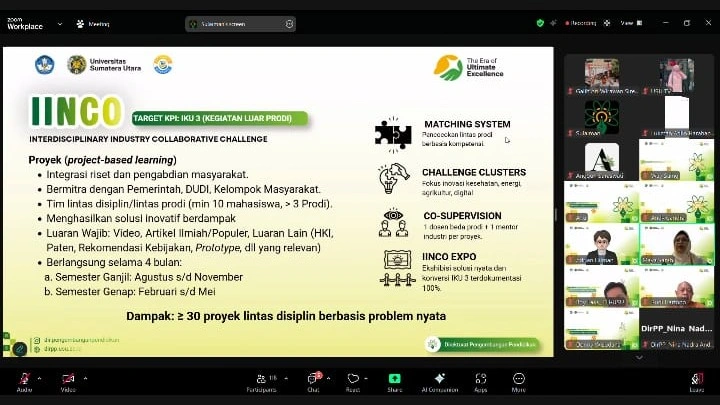
Prof. Ir. Maya Sarah, S.T., M.T., Ph.D., IPM. introduced INCO, a new flagship initiative launched by the Rector of USU. Designed as a project-based learning program to support the achievement of Key Performance Indicator (KPI) 3, INCO requires each project team to consist of at least 10 students from a minimum of three different study programs. Students collaborate with lecturers, industry partners, and heads of study programs to develop innovative solutions to real-world challenges.
"This is a project-based learning program in which students conduct research while also engaging in community service. Each team consists of at least 10 students from a minimum of three different study programs. Through this collaborative approach, students are expected to develop innovative solutions that create meaningful impact," she explained.
On the internship program, Riyanto Sinaga, S.Si., M.Si., outlined four internship clusters available for the semester: independent internships organized by study programs or faculties, USU partner internships, National Research and Innovation Agency (BRIN) research internships, and impact-driven internships.
Meanwhile, Ismayadi, S.Kep., Ns., M.Kes., explained that the Thematic Community Service Program (KKN-T) will strengthen coordination with local governments and require students to conduct village potential surveys before program implementation. These measures are intended to ensure that community service activities are better targeted and more responsive to local needs.


