

Community Service Team from USU Introduces Used Cooking Oil Processing Innovation in Langkat Regency
.webp?w=1280&q=75)


Community Service Team from USU Introduces Used Cooking Oil Processing Innovation in Langkat Regency
Published by
Raisha Andini
Published at
Wednesday, 05 August 2026


The community service project was led by Prof. Dr. Poppy Anjelisa Zaitun Hasibuan, S.Si., M.Si., Apt., with team members Dr. Embun Suci Nasution, S.Si., M.Farm., Klin. Apt., Apt. Ovalina Sylvia Br. Ginting, S.Far., M.Si., Adika Fajar Putra, S.E.I., M.M., and Prof. Madya Dr. Mazlina binti Mohd Said from Universiti Kebangsaan Malaysia.
LANGKAT REGENCY – USU PR: What is often regarded as worthless used cooking oil actually holds significant potential to improve community livelihoods. This idea underpinned a community service program conducted by the Universitas Sumatera Utara (USU) through a training program on producing food-grade dishwashing soap for women as part of post-flood economic recovery efforts in Padang Tualang Village, Padang Tualang District, Langkat Regency, on Friday (31/07/2026). The program equipped community members with the skills to transform used cooking oil into environmentally friendly, marketable products.
The community service project was led by Prof. Dr. Poppy Anjelisa Zaitun Hasibuan, S.Si., M.Si., Apt., with team members Dr. Embun Suci Nasution, S.Si., M.Farm., Klin. Apt., Apt. Ovalina Sylvia Br. Ginting, S.Far., M.Si., Adika Fajar Putra, S.E.I., M.M., and Prof. Madya Dr. Mazlina binti Mohd Said from Universiti Kebangsaan Malaysia.
The floods that struck Sumatra between November and December last year had a significant impact on household livelihoods. In several areas of North Sumatra, many families experienced declining incomes as economic activities were disrupted and sources of livelihood were damaged. This situation compelled communities to seek alternative sources of income to meet their economic needs.
Empowering Women as Drivers of Economic Recovery
Amid efforts to restore the local economy after the floods, women's empowerment has become a strategic approach to strengthening family resilience. One promising business opportunity is converting used cooking oil into food-grade dishwashing soap with economic value. By enhancing entrepreneurial skills and community empowerment, women can establish businesses with relatively low capital requirements.
USU Vice Rector for Academic Affairs, Student Affairs, and Alumni, Prof. Dr. Poppy Anjelisa Zaitun Hasibuan, S.Si., M.Si., Apt., explained that used cooking oil generated from household activities is often discarded directly into the environment. In some cases, it is even illegally reused as cooking oil, posing risks to both public health and the environment.
"Based on these conditions, our team chose to conduct training on producing dishwashing soap from used cooking oil because the technology is simple, easy to learn, utilizes waste materials readily available within the community, and produces an economically valuable product that is needed in daily life," Prof. Poppy explained.
The initiative aims to create new income opportunities for local communities by promoting home-based businesses that utilize inexpensive, readily available raw materials with significant economic value.
The training participants were women aged 25–45 residing in Padang Tualang Village, representing diverse social and economic backgrounds. They included farmers, homemakers, young women, community health volunteers (posyandu cadres), village officials, and other community representatives.
The program included educational sessions on Clean and Healthy Living Behavior (PHBS), hygiene, and sanitation to improve public health awareness. Participants also received hands-on training in converting used cooking oil into food-grade dishwashing soap. In addition, they participated in post-flood disaster response activities with Save the Children and received entrepreneurship, business management, and marketing training through collaboration with the Faculty of Economics and Business USU, the Faculty of Pharmacy USU, and the Faculty of Pharmacy, Universiti Kebangsaan Malaysia (UKM).
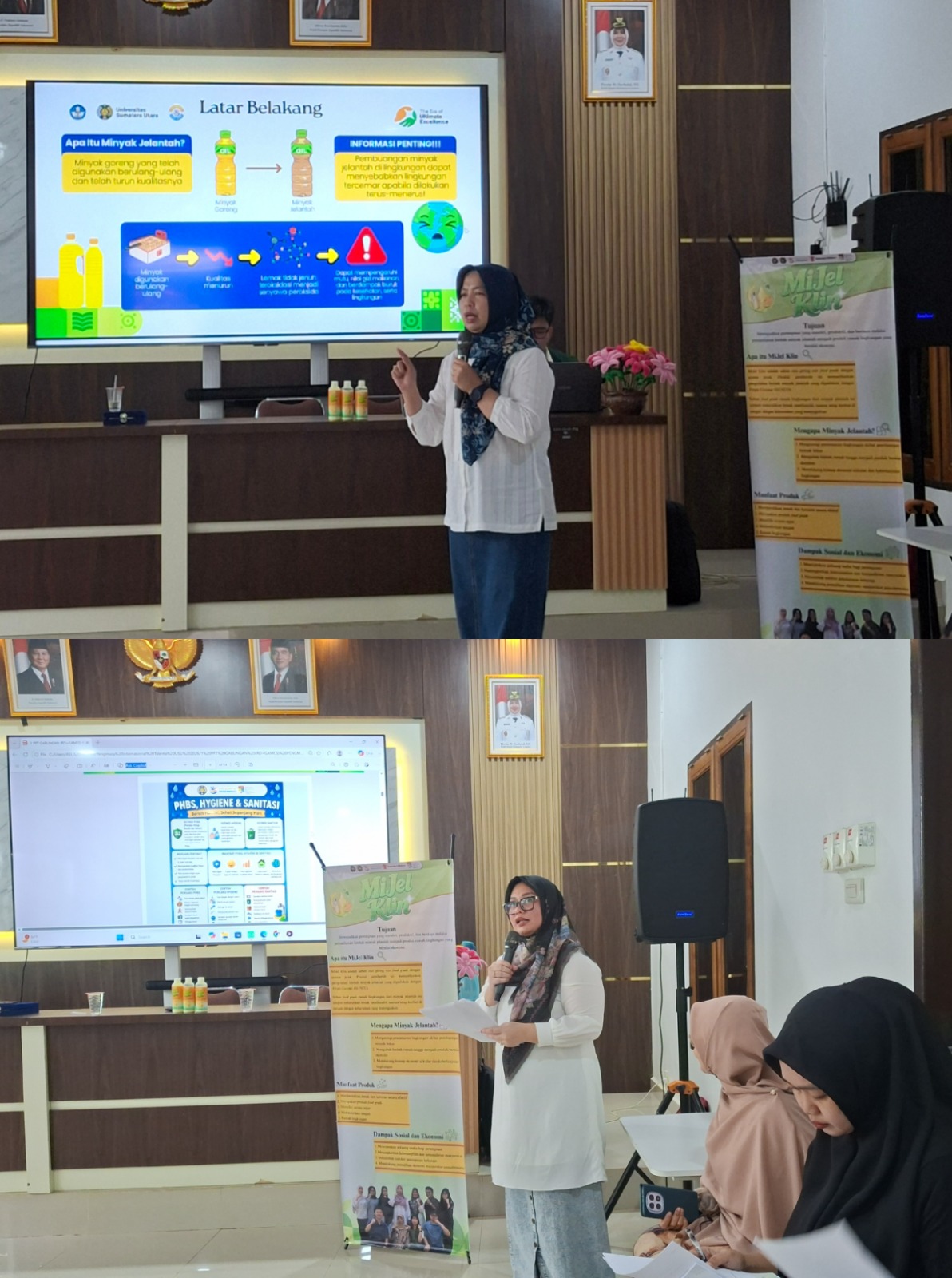
Transforming Waste into Economic Value
Converting waste into marketable products represents an innovative waste-to-value business model that transforms environmental challenges into economic opportunities. Products made from recycled raw materials, such as used cooking oil, have growing market appeal as consumers increasingly prefer environmentally friendly (eco-friendly) products, providing a competitive advantage over conventional alternatives.
Prof. Poppy further explained that before being processed into food-grade dishwashing soap, used cooking oil must undergo several purification stages to ensure its quality and safety. The process begins with filtration to remove food residues, followed by sedimentation for 24–48 hours and successive filtration stages.
Next, the oil undergoes dehydration to remove moisture, followed by quality testing, including pH level, water content, acid value, color, and odor. Once the oil meets the required standards, it is processed through saponification, using sodium hydroxide (NaOH) for solid soap or potassium hydroxide (KOH) for liquid soap. The final stage involves adding surfactants, fragrance, and coloring before the product is packaged.
"Used cooking oil discarded into waterways forms an oil layer on the water's surface, obstructing oxygen exchange and disrupting aquatic ecosystems. Processing used cooking oil into dishwashing soap is a form of upcycling, transforming waste into a valuable product while reducing its negative environmental impact and supporting the circular economy," Prof. Poppy explained.
Through this program, the team hopes participants will continue developing the skills they have acquired into sustainable productive businesses. The establishment of community business groups coordinated by the village government is expected to support production, raw material procurement, and product marketing more effectively and efficiently.
Participants are also encouraged to confidently start their own businesses, continue innovating in product development, maintain product quality, and build networks with other micro, small, and medium enterprises (MSMEs), thereby improving household incomes while promoting more environmentally responsible household waste management.
The program was further strengthened through collaboration with Save the Children, which distributed 100 school bags complete with learning supplies to children affected by the floods as part of efforts to support the recovery of the education sector.


