

Together with Alumni, USU Rector Emphasizes Adaptation and Change


Together with Alumni, USU Rector Emphasizes Adaptation and Change
Published by
Raisha Andini
Published at
Tuesday, 06 October 2026


USU PUBLIC RELATIONS – Indonesia’s banking industry is entering 2027 with a relatively solid foundation while facing increasingly complex structural challenges. Credit growth reached 13.65% year-on-year as of August 2026, with a capital ratio of 24.1% and a non-performing loan (NPL) ratio of 2.11%. Amid these conditions, technological developments, cybersecurity threats, regulatory changes, macroeconomic uncertainty, ESG demands, and talent gaps are challenges that need to be anticipated simultaneously.
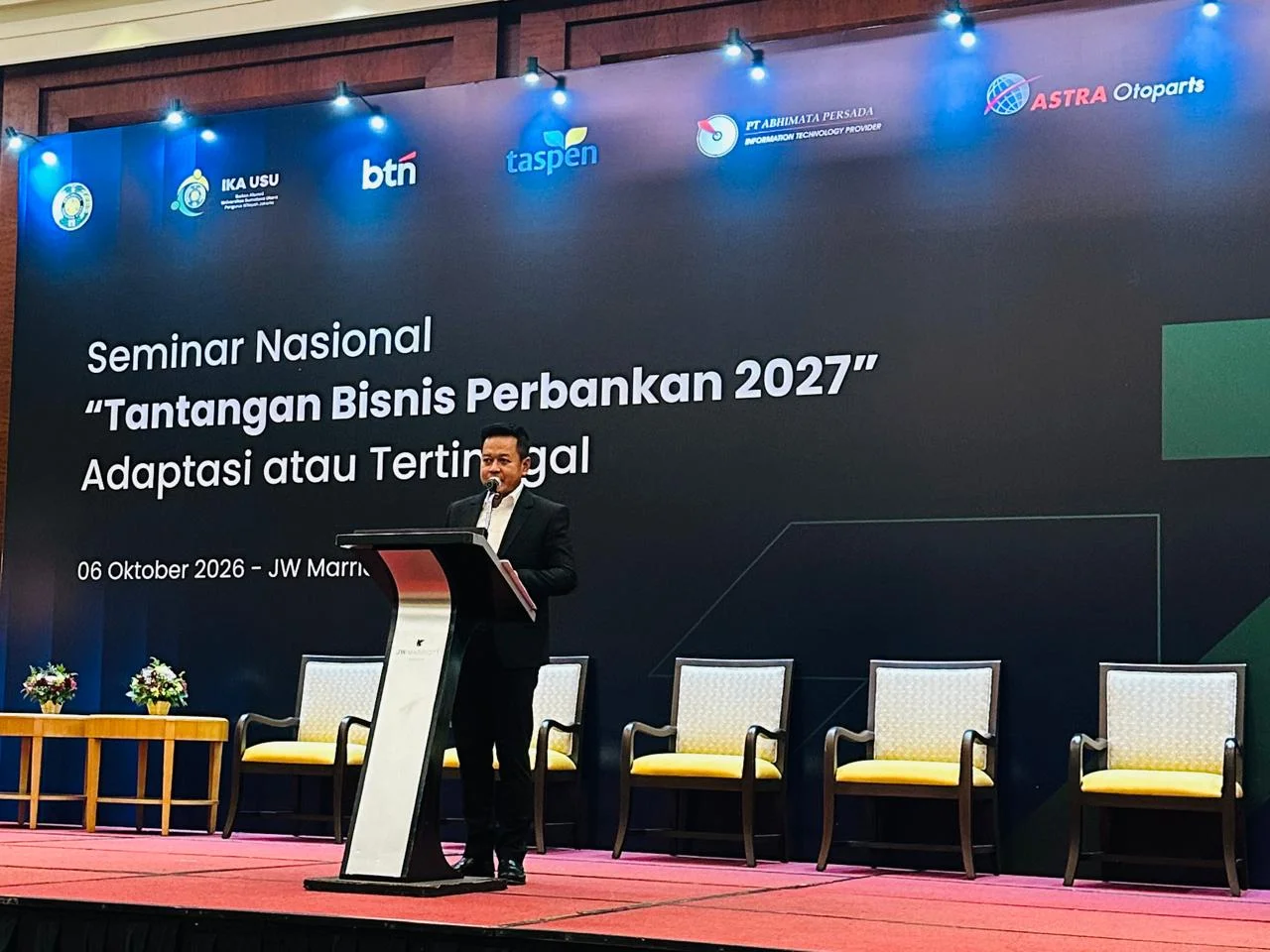
In response to these developments, the Jakarta Chapter of the Alumni Association of Universitas Sumatera Utara (IKA USU Jakarta) organized the National Seminar titled “Banking Business Challenges 2027 – Adapt or Fall Behind” in Jakarta on Tuesday (October 6, 2026), under the theme “Taming Risks, Mastering Technology: Seven Key Challenges for Indonesia’s Banking Industry toward 2027.”
The seminar brought together regulators, banking institutions, fintech companies, academics, and practitioners to discuss strategies for addressing changes in the industry.
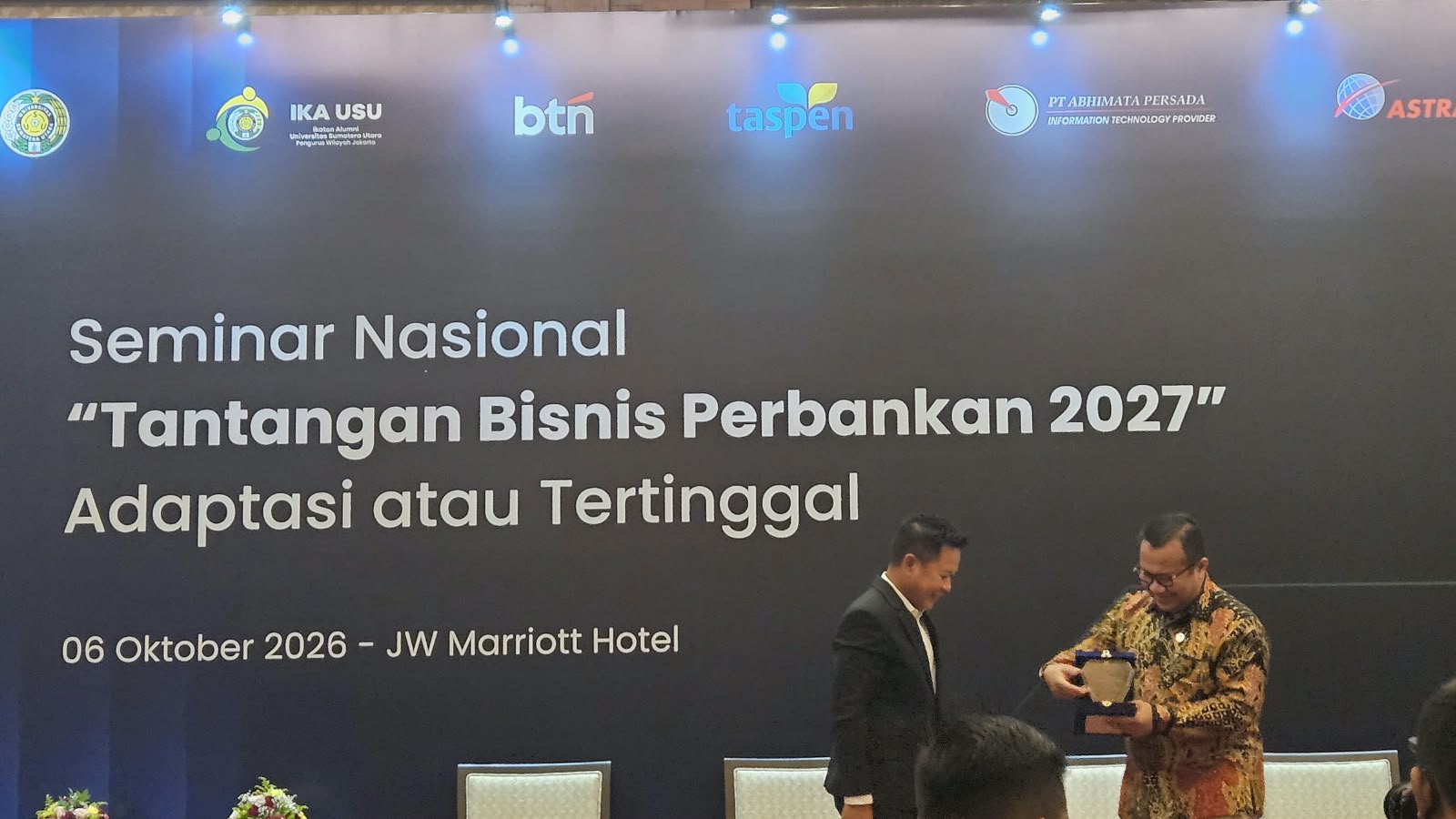
Rector of Universitas Sumatera Utara, Prof. Dr. Muryanto Amin, S.Sos., M.Si., said that the seminar’s theme was not only relevant to the banking industry but also closely related to higher education. Technological developments, advances in artificial intelligence (AI), changing workforce demands, and shifts in the characteristics of student generations require higher education institutions to continuously adapt.
“The concept of adapting or falling behind is also relevant to what we face at Universitas Sumatera Utara. Higher education institutions must adapt to change. If we are unable to adapt, we will fall behind,” said Prof. Muryanto Amin.
The Rector of USU explained that adaptation in higher education extends beyond keeping pace with technological developments. It also involves changes in mindset, governance, learning processes, human resource development, and the institution’s ability to understand the needs of society and industry.
Prof. Muryanto Amin emphasized that higher education institutions need to build an education ecosystem that is responsive to change so that graduates possess competencies aligned with the demands of the times.
“Adaptation must become part of the organizational culture. We must be able to anticipate change, understand the needs of society, and then translate them into policies, education, research, and community service,” he said.
Chairman of IKA USU Jakarta, Tujuh Martogi Siahaan, stated that the challenges facing the banking industry toward 2027 no longer emerge one at a time but simultaneously—from macroeconomic and regulatory risks to technological disruption, cybersecurity, AI, sustainability, and talent. Therefore, it is not enough merely to adapt to change; the industry must also be able to anticipate it.
“Through this seminar, IKA USU Jakarta seeks to bring together regulators, industry players, and academics to build a shared perspective and formulate concrete steps so that Indonesia’s banking industry becomes increasingly resilient, adaptive, and competitive,” he said.
Seven Strategic Challenges
The seminar identified seven key challenges facing the banking industry: digital disruption and fintech; cybersecurity and data protection; AI adoption; regulatory and compliance pressures; credit risk and macroeconomic conditions; ESG; and human resources.
These seven challenges are interconnected and therefore require an integrated response. From a technological perspective, competition among banks, fintech companies, neobanks, and digital payment platforms is becoming increasingly intense. AI offers opportunities to improve credit scoring, fraud detection, and efficiency, while also creating new risks such as AI-powered fraud and deepfakes. Meanwhile, changes in reporting standards, alignment with Basel standards, and strengthened oversight and data protection require the industry to enhance its capacity for adaptation and compliance.
Digitalization Must Deliver Productivity and Tangible Benefits
Executive Head of the Financial Sector Technological Innovation, Digital Financial Assets, and Crypto Assets Supervision, Adi Budiarso, emphasized that the future of the financial services sector will be determined not only by the speed of innovation but also by its ability to maintain stability, security, governance, consumer protection, and economic benefits.
“Digital transformation in the financial sector must be directed toward becoming a productivity engine that expands access to financing and provides tangible benefits to the real sector and society.”
From a prudential perspective, the Basel framework places capital adequacy, supervisory review, and market discipline as the three pillars of supervision. Meanwhile, PSAK 118 strengthens the quality and structure of financial information presentation. A combination of adequate capitalization, effective supervision, disciplined risk management, and transparency serves as an important foundation for stability and market confidence.
Consolidation, Risk, and Cybersecurity
Chairman of the Business Competition Supervisory Commission (KPPU), Gopprera Panggabean, stated that banking consolidation and restructuring are necessary to strengthen the industry’s efficiency and financial health. However, these processes must continue to safeguard fair business competition, innovation, consumer choice, and access to financing. Market concentration and the declining number of effective competitors also require attention.
President Director of BTN, Nixon L.P. Napitupulu, emphasized that digital transformation must generate tangible economic impacts. BTN has developed process transformation initiatives through Loan Factory, the Monoline Collection System, AI/OCR, Core Banking modernization, BDS, and AS400 to strengthen efficiency, governance, and risk management.
“Technology is not the ultimate goal of transformation in the financial sector. Its true value lies in its ability to expand access to financing, improve efficiency, strengthen resilience, and drive the real sector,” he said.
From a risk management perspective, Johanes Barus, Director of Risk Management at BTN, emphasized the need to shift from a reactive approach toward risk management that is more proactive, measurable, and data-driven. The use of AI and advanced analytics is considered capable of enhancing banks’ ability to make more predictive and adaptive decisions.
At the same time, the National Cyber and Crypto Agency (BSSN) emphasized that cybersecurity has become a business risk that can affect operations, finances, reputation, legal matters, and business continuity.
Therefore, digital transformation must go hand in hand with strengthened resilience, governance, data protection, and system security.
“Innovation without resilience can become a systemic vulnerability. Therefore, as the financial sector becomes increasingly digital, cybersecurity must shift from merely being an IT function to becoming part of business strategy and continuity.”
From Digitalization to Autonomous Intelligence
The next challenge is to advance digitalization from partial automation toward integrated autonomous intelligence. The use of chatbots, RPA, OCR, and various digital tools needs to be integrated through a foundation of data, multi-agent architecture, human oversight, and governance.
The goal is to build increasingly intelligent systems without losing control, security, accountability, and trust. However, technological progress must also be accompanied by stronger safeguards for fair competition.
Professor of Business Competition Law at USU, Prof. Dr. Ningrum Natasya Sirait, S.H., M.Li., stated that digital transformation does not automatically create healthy competition. The shift in market power toward data, algorithms, and digital infrastructure creates risks such as ecosystem lock-in, self-preferencing, exclusivity, and the acquisition of potential competitors.
Therefore, competition policy needs to become more preventive and be implemented from the product-design stage.
Collaboration as the Key to Banking in 2027
The seminar emphasized that the seven challenges facing the banking industry cannot be addressed by any single party. Synergy among the government, regulators, industry, academics, media, and communities is needed to ensure that innovation advances not only technologically but also remains safe, inclusive, socially meaningful, and economically sustainable.
With technology as the driving force, governance as the compass, security as the foundation, and collaboration as the strength, Indonesia’s banking industry is expected to enter 2027 with greater intelligence, resilience, inclusivity, and sustainability while delivering greater benefits to society and the Indonesian economy.


