

USU Holds Meaningful Public Participation Hearing on Draft Amendments to State Finance Law
.webp?w=1280&q=75)


USU Holds Meaningful Public Participation Hearing on Draft Amendments to State Finance Law
Published by
Raisha Andini
Published at
Thursday, 22 October 2026


MEDAN, USU PUBLIC RELATIONS – Universitas Sumatera Utara (USU) hosted the Meaningful Public Participation Hearing on the Draft Amendments to the State Finance Law on Thursday (October 22, 2026), at the USU Faculty of Law. The event served as a forum for academics and the government to provide input toward improving state finance regulations, particularly regarding regulatory harmonization and legal certainty in the management of state assets.
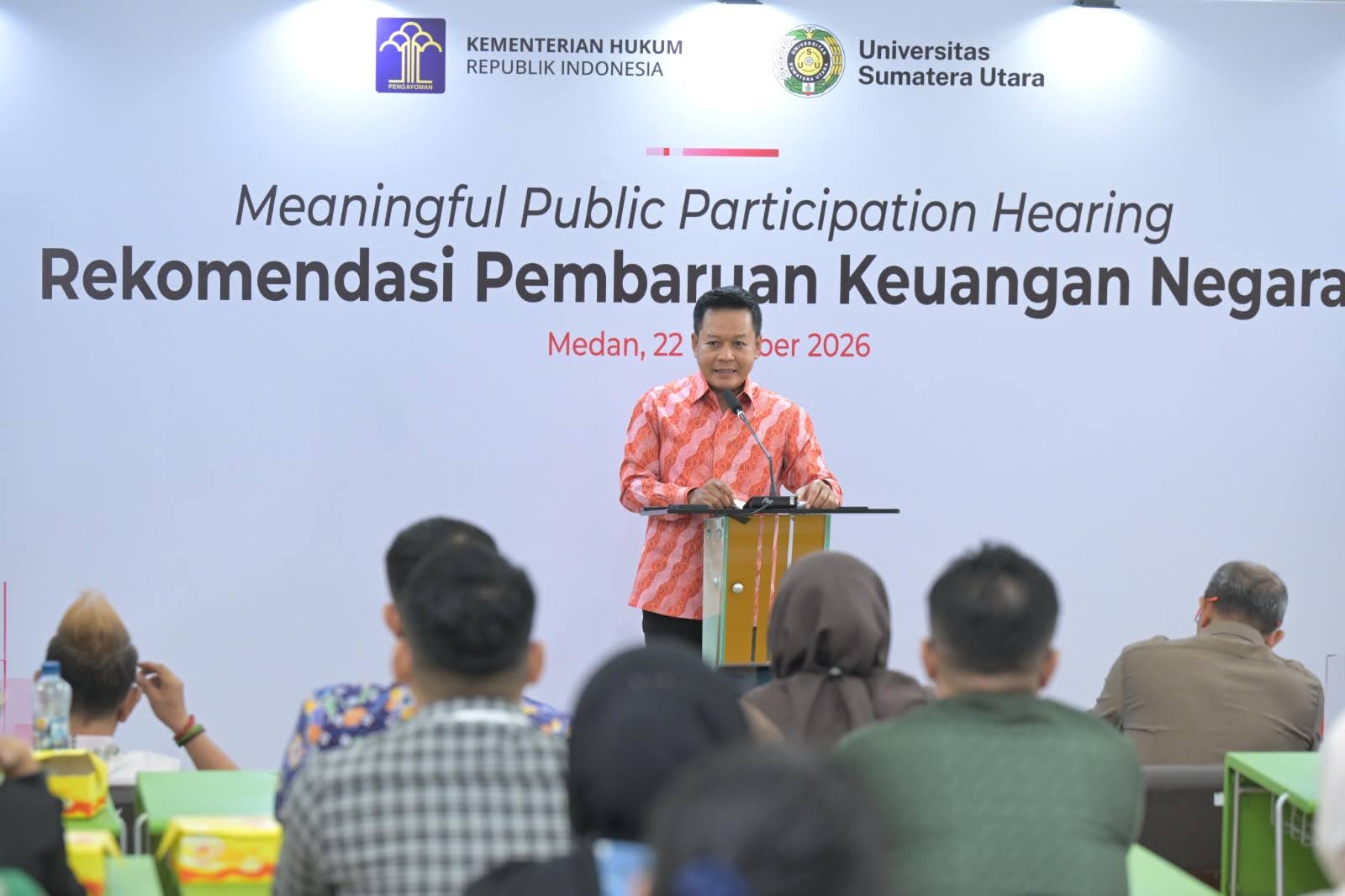
(Photo: Muhammad Andriansyah)
In his remarks, USU Rector Prof. Dr. Muryanto Amin, S.Sos., M.Si., expressed his appreciation to the Ministry of Law of the Republic of Indonesia for selecting USU as the venue for the forum. He expressed hope that the discussion would generate input for improving state finance regulations, including regulations on the management of assets owned by Legal Entity State Universities (PTN-BH) to support the financing needs of higher education.
“Hopefully, this event can provide valuable insights for all of us regarding this very important Draft Law on State Finance,” he said.
In his remarks, Dean of the USU Faculty of Law Dr. Mahmul Siregar, S.H., M.Hum., highlighted legal uncertainty resulting from the lack of alignment among various regulations concerning state finance, particularly those governing the management of State-Owned Enterprises (BUMN). He noted that such conditions could make decision-makers hesitant to invest and pursue innovation.
“This uncertainty has caused many BUMN managers to be concerned about making decisions and afraid to invest,” he said.
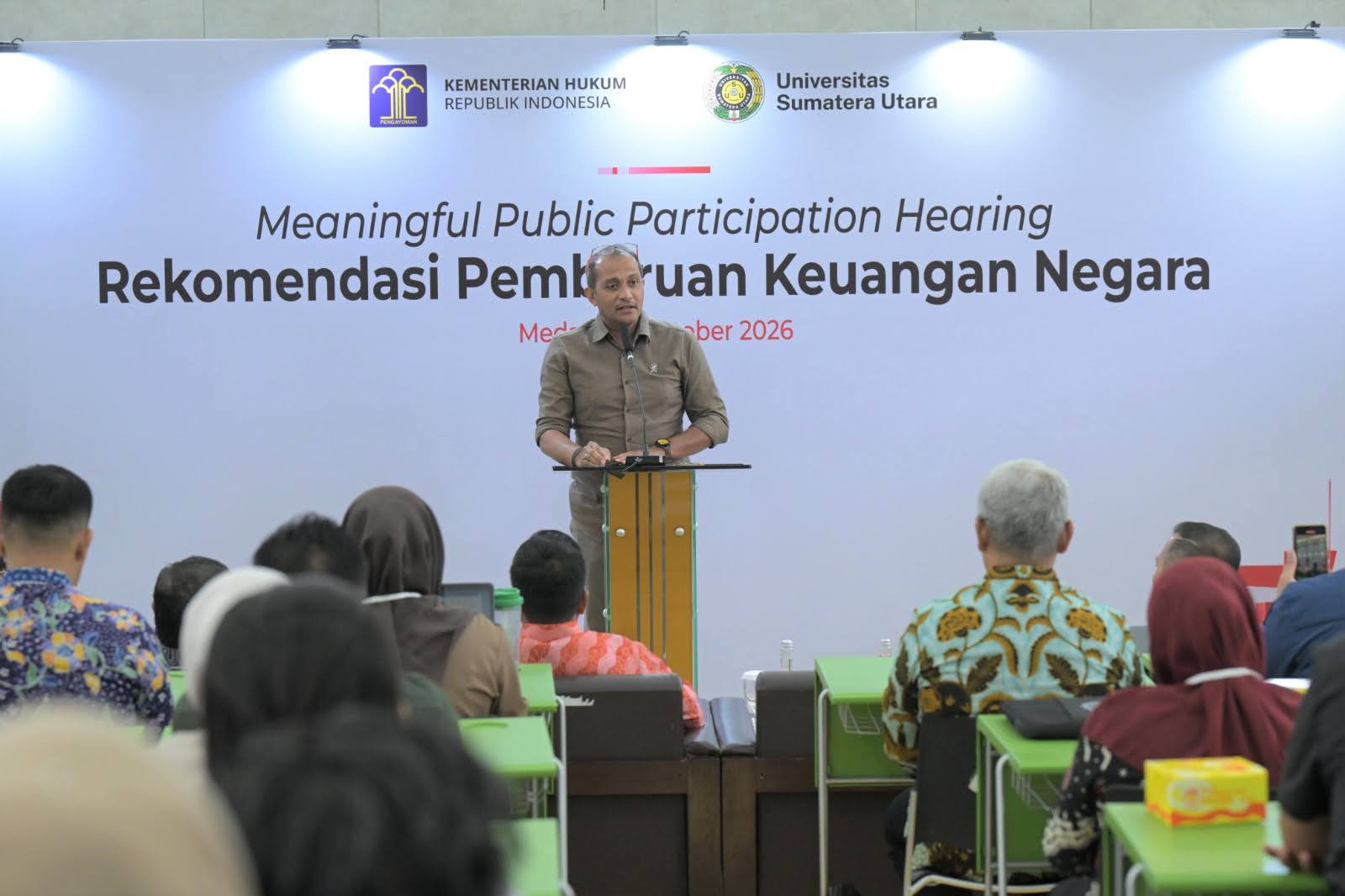
(Photo: Muhammad Andriansyah)
In his keynote speech, Deputy Minister of Law of the Republic of Indonesia Prof. Dr. Edward Omar Sharif Hiariej, S.H., M.H., emphasized the importance of harmonizing laws and regulations to establish consistent standards for the management of state assets, particularly at BUMNs. He explained that regulatory alignment was also necessary to clarify legal accountability and prevent differing interpretations in handling cases involving losses to state finances.
“This synchronization and harmonization are important for all of us,” he said.
Furthermore, he highlighted the need for uniform standards in auditing state financial losses to prevent different audit findings for the same object. According to him, regulatory alignment is also necessary to establish clear legal boundaries in the application of provisions concerning corruption offenses.
“What must not happen is for law enforcement officials to calculate state financial losses without applying the same standards,” he stressed.
Dean of the USU Faculty of Law Dr. Mahmul Siregar, S.H., M.Hum., explained that the forum marked an initial stage in the lengthy process of improving state finance regulations. The involvement of higher education institutions provides academics with an opportunity to contribute their research findings and expertise to policymaking.
“Our contribution as a state university, particularly the Faculty of Law, is to provide insights based on the expertise of our lecturers and teaching staff and contribute to the formulation of draft policies,” he explained.
He added that the USU Faculty of Law would follow up on the outcomes of the forum by developing further lecturer research and submitting academic input to the government. Continued collaboration with the Ministry of Law is also expected so that studies on state finance regulations can be conducted more comprehensively.
“Certainly, we also hope that we can continue collaborating with the Ministry of Law to further develop ideas and perspectives on this matter,” he added.
Through the Meaningful Public Participation Hearing, USU is expected to strengthen the contribution of academics to the public policymaking process while encouraging improvements to state finance regulations that provide legal certainty and support accountable state financial governance.


