

Lessons from Europe’s Heatwave: Traditional Batak Houses Prove Zero-Carbon Architecture Already Existed


Lessons from Europe’s Heatwave: Traditional Batak Houses Prove Zero-Carbon Architecture Already Existed
Published by
Zulfahmi Purba, A.Md
Published at
Tuesday, 21 July 2026


The extreme heatwave that hit Europe in June–July 2026 underscored the flaws of post-World War II modernist architecture. According to Dr. Ir. Ar. Achmad Delianur Nasution, a lecturer in Architecture at USU's Faculty of Engineering, Indonesia has actually had the solution for hundreds of years, one example being the traditional architecture of Batak indigenous houses, which applies zero-carbon principles through natural materials as well as natural lighting and ventilation.
Europe is burning once again. Throughout June–July 2026, an extreme heatwave swept across Europe, triggering forest fires in France and the Iberian Peninsula. The Fabra Observatory in Barcelona even recorded a temperature of 40.5°C on 8 July, the highest in more than a century. The United Kingdom also recorded a new high for the number of days with temperatures above 34°C in a single year.
This crisis is once again a reminder that architectural modernism, with its glass and aluminum buildings uniform across the world, has contributed to worsening global warming. Yet long before the world scrambled to find a solution, Indonesia already had the answer, embedded in the traditional houses built by our ancestors hundreds of years ago.
According to Dr. Ir. Ar. Achmad Delianur Nasution, M.T., IAI., IAP., GP., a lecturer in the Architecture Study Program at the Faculty of Engineering, Universitas Sumatera Utara (USU), that answer has long existed within the local wisdom of Indonesian archipelagic architecture.
Architecture as a Mirror of Civilization
Architecture, Achmad Delianur explains, is not merely about buildings. It is part of culture, and culture is part of civilization. Civilization itself is formed through the interaction between people, nature, and the environment in which they live.
For this reason, every ethnic group in Indonesia has developed its own distinctive character and local wisdom in responding to its respective environment. One of the clearest examples is the traditional Batak house.
Traditional Batak Houses: Zero Carbon Since Ancient Times
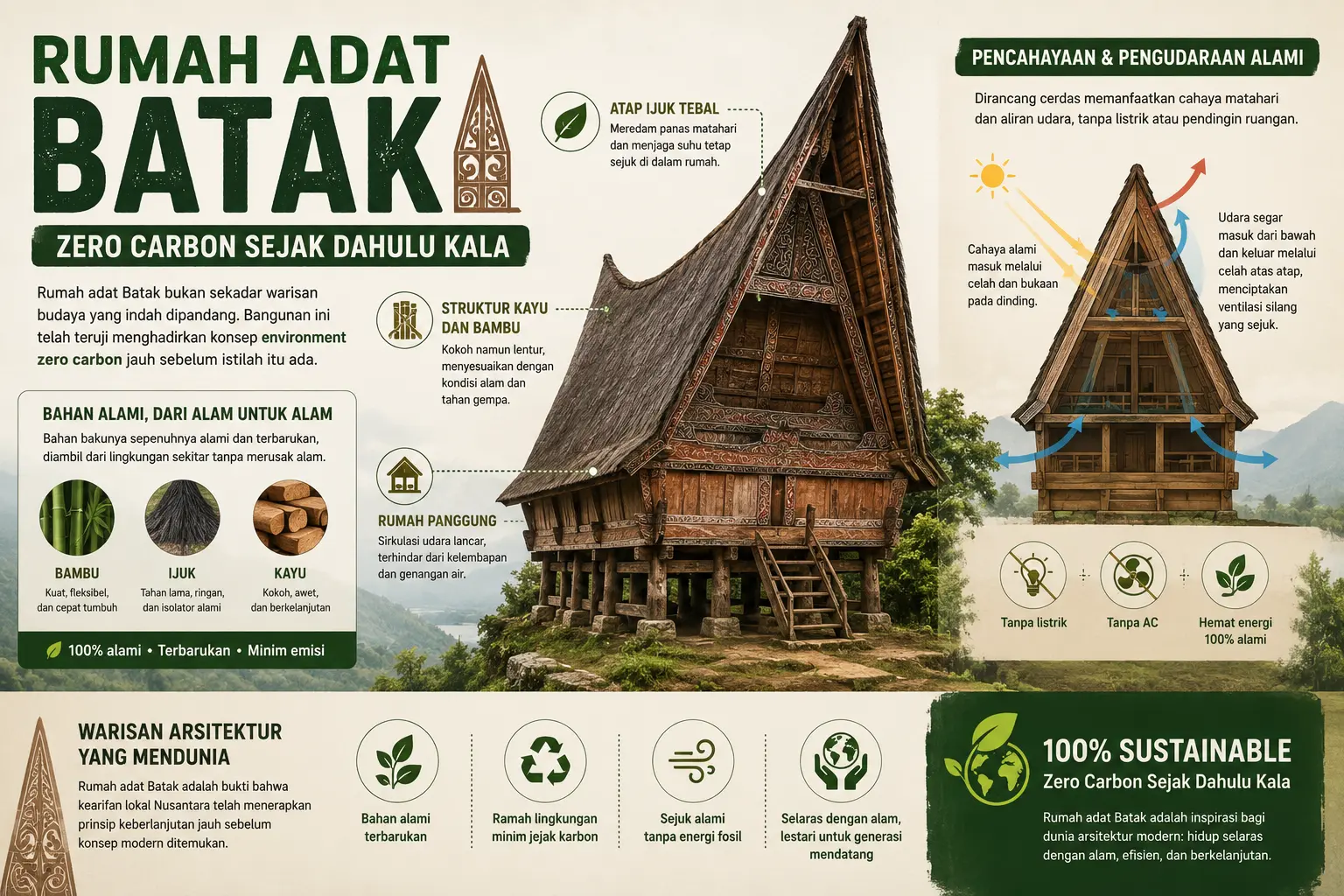
The traditional Batak house is not merely a beautiful cultural heritage to look at. This structure has long proven capable of embodying the concept of a zero-carbon environment long before the term itself existed.
Its materials are entirely natural: bamboo, sugar palm fiber (ijuk), and wood. Its structure is designed around natural lighting and natural ventilation, without relying on electricity or air conditioning. As a result, the traditional Batak house is 100% sustainable, a concept that has now become a central goal of modern architecture.
Green architecture is an approach to building design that minimizes negative environmental impact through natural materials, energy efficiency, and natural lighting and ventilation, while still meeting the needs of its occupants.
Wisdom of this kind, passed down by our ancestors, is known as traditional culture: a practice that, without anyone realizing it, had already applied the principles of green architecture long before the term was formally coined by the modern world.
When Modernism Changed the Face of the World
Yet this traditional culture underwent a major shift after World War II. Many newly independent nations rushed to build according to a single shared concept: modernism.
As a result, buildings around the world became uniform, dominated by glass and aluminum that absorb and trap heat. This trend has continued to this day, and has contributed to the climate crisis that has now culminated in extreme heatwaves such as the one currently affecting Europe.
Global Awareness and the Birth of Green Architecture
The next phase came when the world realized that global warming, if left unaddressed, would devastate the planet and leave nothing to pass on to future generations.
Around the 1980s and 1990s, a global movement emerged to halt global warming. In the field of architecture, this movement became known as green architecture. In Indonesia, this awareness was eventually formalized through official regulation: Minister of Public Works and Housing Regulation No. 02/PRT/M/2015 on Green Buildings, later reinforced by Minister of Public Works and Housing Regulation No. 21 of 2021 on the Performance Assessment of Green Buildings. These regulations require every architectural work to avoid contributing to global warming.
The SDGs and Local Wisdom That Already Existed
Herein lies both the irony and the pride: the principles embedded in the SDGs (Sustainable Development Goals) set by the United Nations were, in fact, already practiced by Indonesia’s ancestors hundreds of years ago, long before the world formally articulated them.
The traditional Batak house, with its natural materials, energy efficiency, and harmony with the environment, is proof that sustainable architecture is not an imported concept. It is a genuine national heritage that was nearly forgotten amid the wave of modernism, but is now relevant once again as an answer to the global climate crisis, including the heatwave currently affecting Europe.
This local wisdom is not merely nostalgia for the past. It is a genuine blueprint for a more environmentally friendly future of architecture.
Quick Q&A
What is green architecture? Green architecture is an approach to building design that is environmentally friendly, energy-efficient, and uses materials with minimal carbon impact, an approach already applied earlier in traditional Batak houses.
Why is the traditional Batak house considered zero carbon? Because all of its materials are natural (bamboo, sugar palm fiber, wood), and it relies on natural lighting and ventilation without electricity, producing no carbon emissions in its daily operation.
What is the connection between the traditional Batak house and the SDGs? The sustainability principles within the SDGs set by the United Nations (energy efficiency, environmentally friendly materials, harmony with nature) were already being practiced in traditional Batak houses long before the SDGs existed.


